
Activitiz selection
Unusual things to do in Marrakech: seven original experiences
For an unusual Marrakech activity, choose an experience you take part in: solve a puzzle, make an object, cook or build a photo story. These seven ideas include places to discover and practical details to check before planning your outing.
Guide updated . Prices carry their own verification dates. Check with the venue for the conditions on your visit date.
Follow a treasure hunt through the medina
Replace a conventional tour with a mission involving stops, puzzles and observation of landmarks. This format suits travellers who remember more by searching than listening. The Sultan’s Quest links seven stops over approximately 3 km: the progress gives the group a shared goal while breaks remain flexible. Check walking distance, monument tickets and language before choosing a treasure hunt.
Discover the Sultan's Quest →Try pottery or zellige with a craftsperson
To bring back more than a purchase, choose a technique to learn. Ateliers d’Ailleurs lists pottery, zellige, leatherwork and other crafts in Marrakech. Ask how much you will do yourself, in which language and with how many participants. Location and duration depend on the session; also confirm whether your creation can leave with you or needs firing later. This is an activity to book around a specific appointment, rather than an improvised shopping stop.
Learn a Moroccan dish at La Maison Arabe
La Maison Arabe offers three-hour cooking workshops or a one-hour express format. Choose the longer option to devote part of your day to preparation and technique; the shorter option fits more easily between visits. Confirm menu, allergies, language and inclusions before paying. Sessions are held at the hotel or Country Club: use the confirmed venue to plan your day and transport.
Create a photo challenge from Koutoubia to Mouassine
Set a small mission: capture a door, a shadow, a geometric pattern and contrasting colours. Start near Koutoubia, cross Jemaa el-Fna, then choose your way through the souks towards Mouassine. Leave roughly 1 h 30 to 2 h in your plan, including breaks, and keep a map to find your way. This editorial suggestion uses public streets freely; interior visits and refreshments are extra. Ask permission before photographing people closely.
See Morocco’s past at the Maison de la Photographie
The archives at the Maison de la Photographie reveal landscapes, portraits and scenes from Morocco’s past. Pick one detail in the images, such as clothing, a façade or transport, then look for what has changed on your next walk. Plan around an hour, or longer if you enjoy reading and observing. The museum states that tickets are purchased on site, not online, and also include the Musée de la Musique: check conditions when visiting.
Follow the water at Le Jardin Secret
At Le Jardin Secret on Rue Mouassine, the pools and channels reveal infrastructure as well as decoration. A khettara is an underground gallery collecting groundwater; the riad benefited from this supply. The water trail explains how it served gardens, kitchens, the hammam and fountains. Leave around an hour for this themed visit, excluding a café break. Admission is charged; the tower costs extra and is restricted for children under 6. Pair it with a souk walk without planning a transfer outside the medina.
Read the city through a historical smartphone trail
If you prefer understanding places to solving a story, Heart of the Red City connects six stops over approximately 2.3 km, with an indicative duration of 90 minutes. Pick one architectural detail at each stop and relate it to the history presented: the activity comes from observation as well as walking. This Activitiz trail is booked on request; wait for confirmation of the conditions. Monument entry is separate from the digital route. To build your own itinerary, also read our self-guided visit guide.
Read the self-guided visit guide →Which experience fits your time and budget?
You can spend an hour looking at old photographs or set aside time to make something yourself. The table compares those formats and the outings you can do without booking a workshop.
La Maison Arabe’s official page describes its formats but does not publish a price on the page consulted: request a quote instead of relying on an unverified range. The same approach applies to craft workshops, where conditions depend on the session. The garden price comes from Le Jardin Secret.
Three ways to plan your half day
Small budget: a photo series and a break
Build a short visual story about how the medina works. Around Koutoubia, photograph a landmark at the scale of the city. At Jemaa el-Fna, choose a view that shows the relationship between open space and the lanes. Towards Mouassine, find a detail that reveals how something is made: joints, weaving or a carved surface. Together the pictures move from city to square to object. This is our suggested theme, not a competition or a supplied game route; ask permission before photographing people.
Make a keepsake: workshop, then a walk
Choose the technique before the souvenir. Pottery starts with shaping clay; zellige composes a surface from ceramic pieces. These are different ways of working, even when both use ceramic material. Ask whether you will shape, paint, cut or assemble, and which stages the craftsperson completes. Then connect the lesson to a monument: at Ben Youssef, the cut-tile decoration shows what precise assembly can produce at architectural scale.
A freshly shaped pottery piece is not necessarily ready for a suitcase. Confirm drying, firing and collection arrangements with the workshop, as well as its address. A demonstration can explain the craft, but it is different from time spent practising the technique yourself.
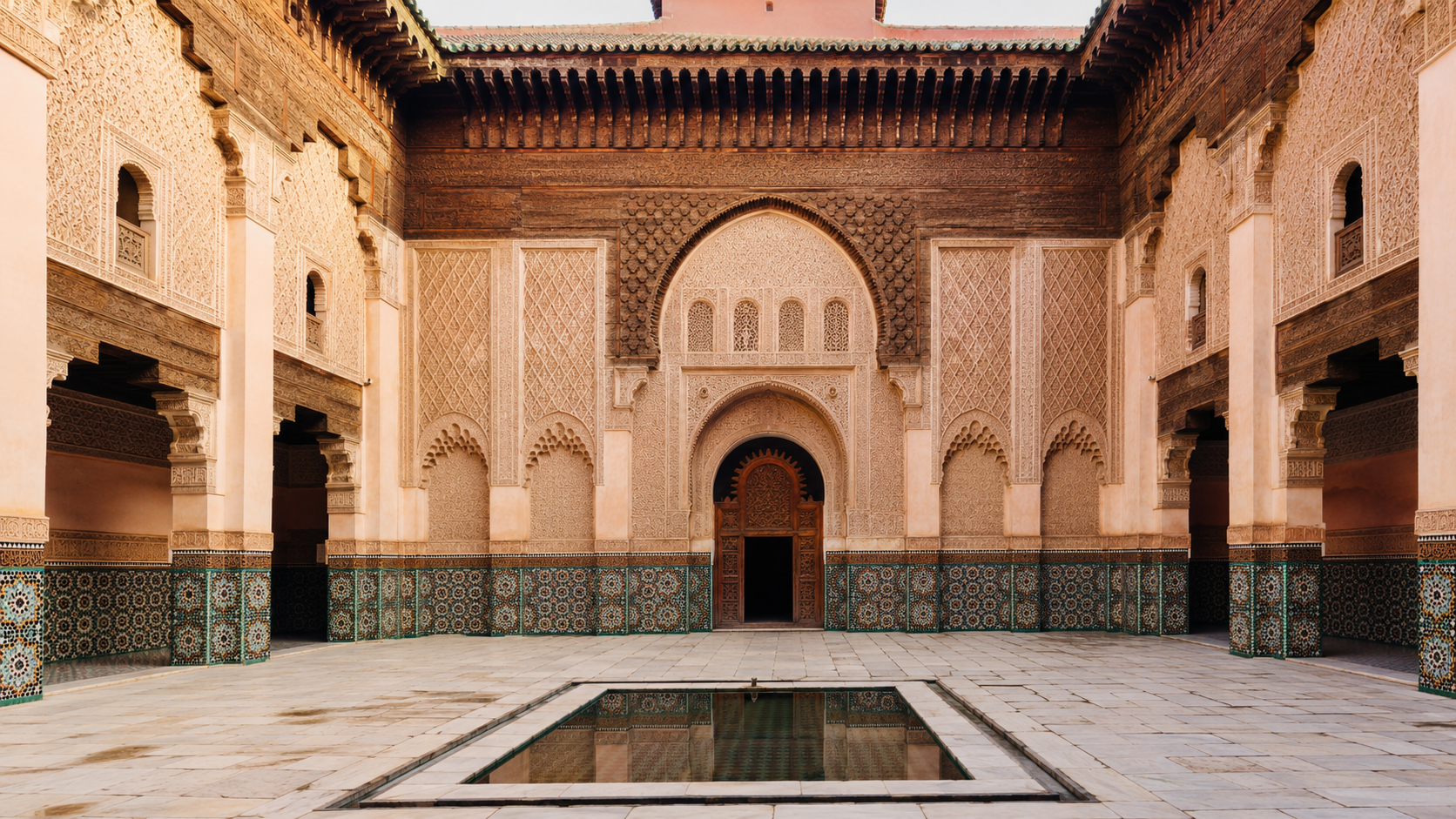
Look differently: a museum, then a street challenge
The Maison de la Photographie presents albumen prints, glass plates and autochromes alongside later photographs. The archive concerns ways of making images as well as what Morocco looked like. Compare a captioned portrait with a street scene: who is posed, what has the photographer selected, and what can the date actually establish? This avoids treating an old photograph as a transparent view of an entire country.
Afterwards, make two images of the same subject with different framing. Discuss how the meaning changes when you include a shop entrance, a passer-by or surrounding traffic. That is a practical way to connect the museum with your own travel photographs. The museum currently sells admission on site and includes entry to the Musée de la Musique; check how to use that second visit when buying.
As a couple, with friends or with children
A shared workshop gives couples time to talk. With friends, a photo challenge lets everyone contribute without needing the same skill level. With children, check attention span and the ages actually accepted by the organiser: “hands-on” does not mean “suitable for every age”. Our family guide provides shorter programmes and example budgets.
Details to confirm before booking a workshop
Before booking pottery, ask whether you’ll shape wet clay or decorate a piece that’s already been fired, and when you can collect it. For a cooking class, ask which steps you’ll do yourself and which ingredients are prepared before you arrive. If you’re booking for children, confirm the age accepted and whether an adult needs to join in.
For a class outside the medina, ask for the exact meeting point and whether transport is included. Leave room in your plans for that journey and, for pottery, a second trip if you need to collect the finished piece.
If you prefer an outing without a reserved appointment, choose a photo walk or a cultural visit within opening hours. For a phone-based treasure hunt, check the Sultan’s Quest and its admission requirements before setting out.